Introduction
In my experience in the bearing business, ZZ vs 2RS is one of the most common questions I hear from factory owners, engineers, maintenance teams, and machine operators.
Both bearing types are commonly used to protect the internal rolling elements from contaminants and retain lubricant. However, their sealing or shielding construction is different, which can affect their suitability for a particular application.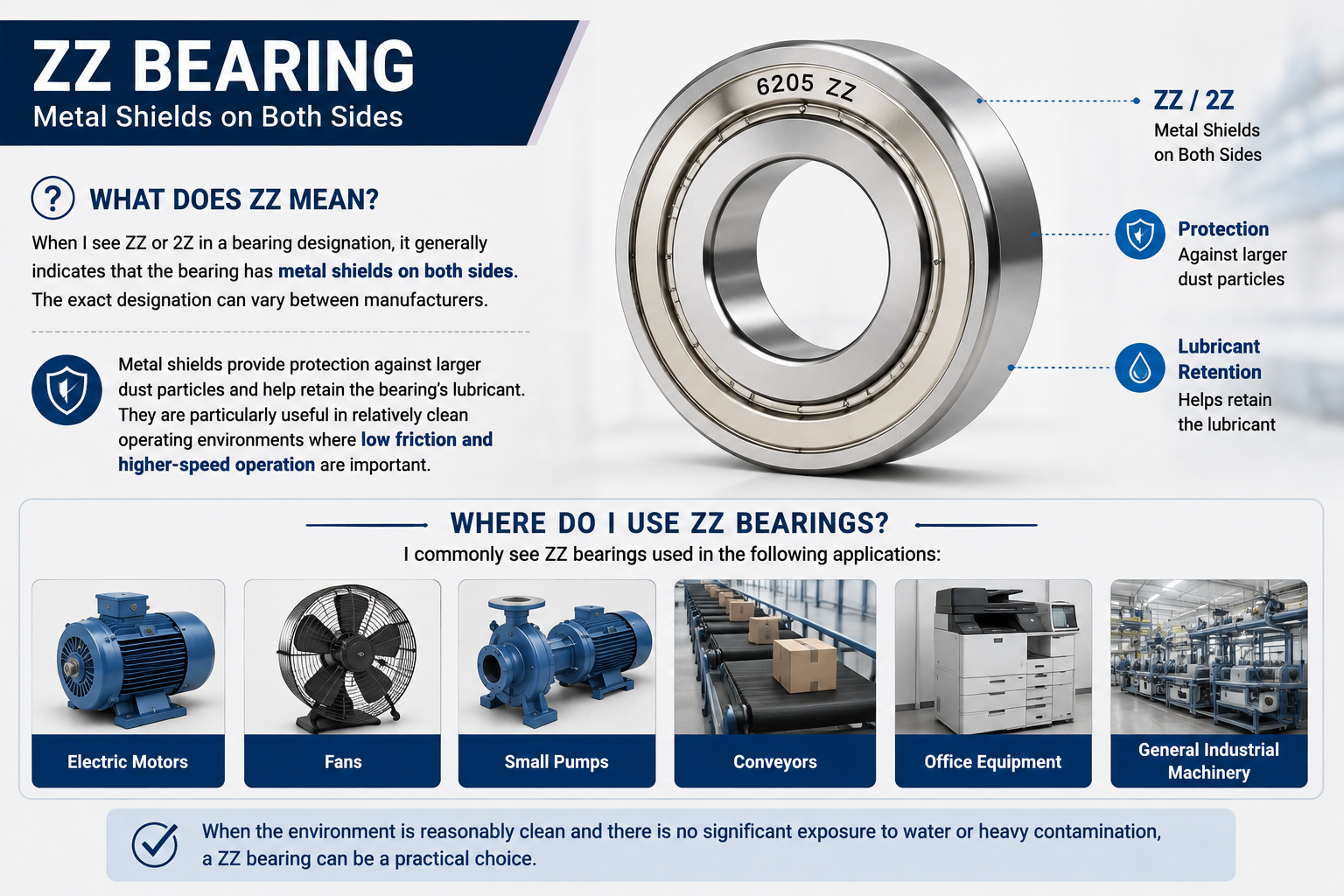
What Does ZZ Mean on a Bearing?
When I see ZZ or 2Z in a bearing designation, it generally indicates that the bearing has metal shields on both sides. The exact designation can vary between manufacturers.
Metal shields provide protection against larger dust particles and help retain the bearing’s lubricant. They are particularly useful in relatively clean operating environments where low friction and higher-speed operation are important.
Where Do I Use ZZ Bearings?
I commonly see ZZ bearings used in applications such as electric motors, fans, small pumps, conveyors, office equipment, and general industrial machinery.
When the surrounding environment is reasonably clean and there is no significant exposure to water or heavy contamination, a ZZ bearing can be a practical choice.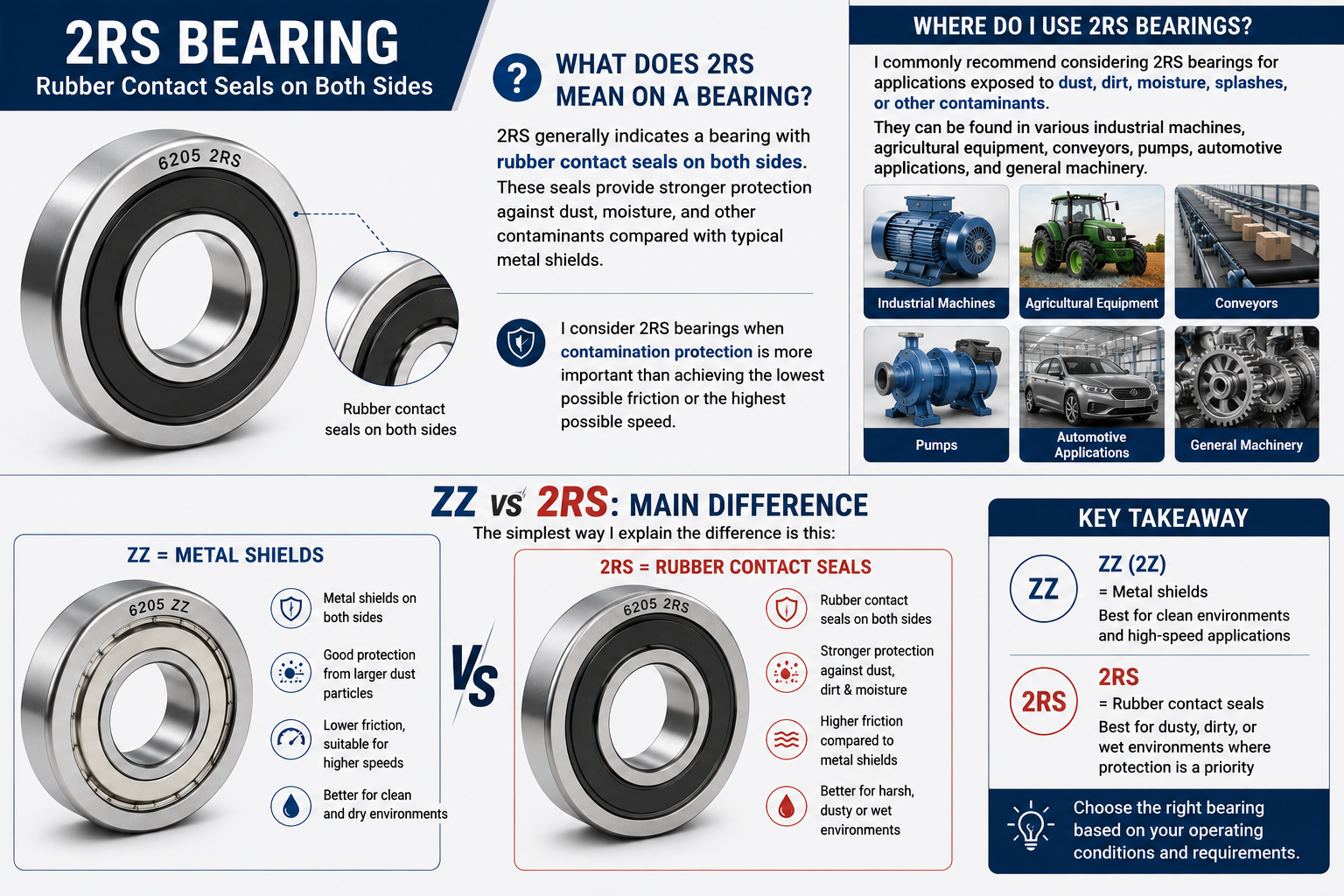
What Does 2RS Mean on a Bearing?
2RS generally indicates a bearing with rubber contact seals on both sides. These seals provide stronger protection against dust, moisture, and other contaminants compared with typical metal shields.
I consider 2RS bearings when contamination protection is more important than achieving the lowest possible friction or the highest possible speed.
Where Do I Use 2RS Bearings?
I commonly recommend considering 2RS bearings for applications exposed to dust, dirt, moisture, splashes, or other contaminants.
They can be found in various industrial machines, agricultural equipment, conveyors, pumps, automotive applications, and general machinery.
ZZ vs 2RS: Main Difference
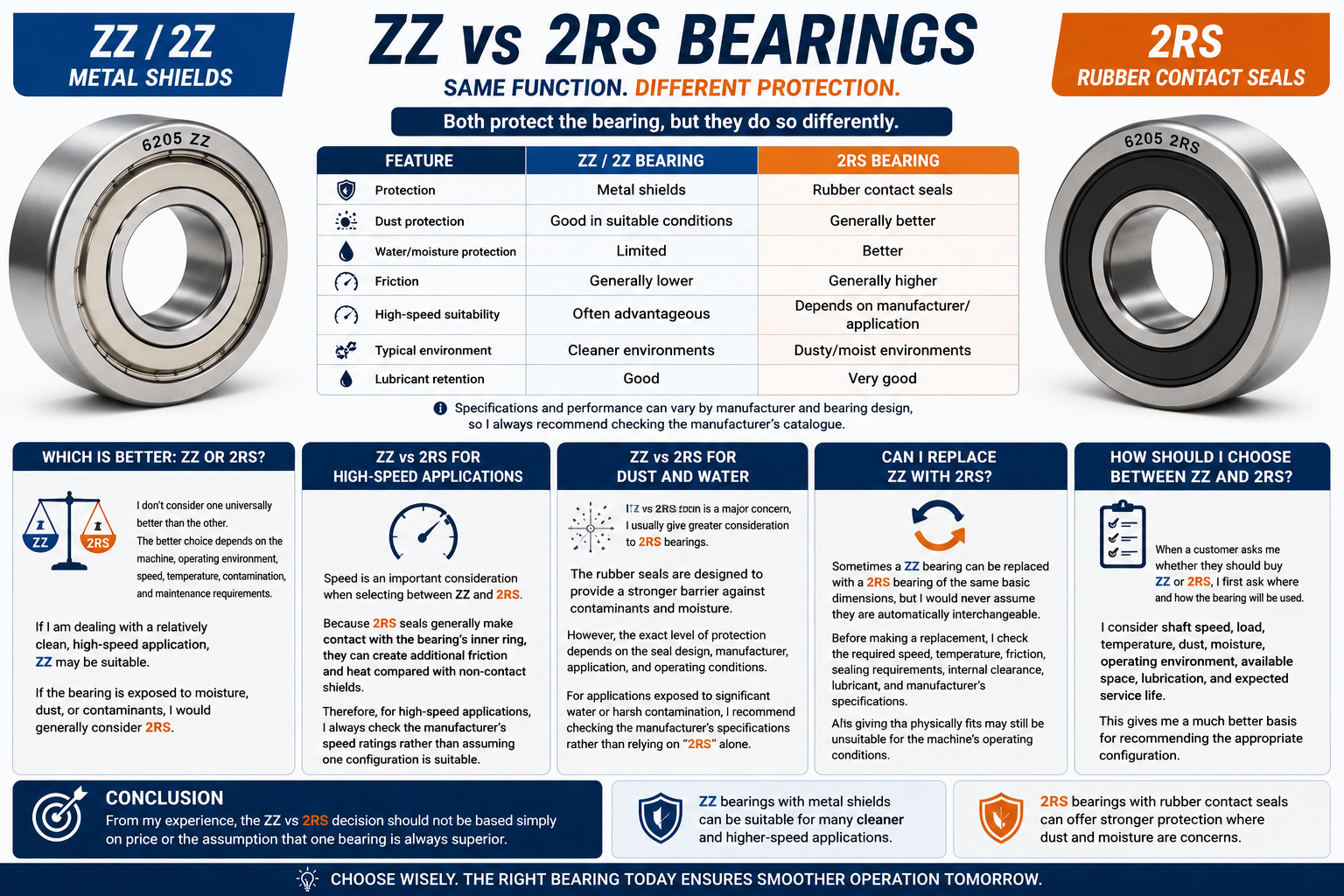
The simplest way I explain the difference is this:
ZZ = Metal shields
2RS = Rubber contact seals
Both protect the bearing, but they do so differently.
| Feature | ZZ / 2Z Bearing | 2RS Bearing |
|---|---|---|
| Protection | Metal shields | Rubber contact seals |
| Dust protection | Good in suitable conditions | Generally better |
| Water/moisture protection | Limited | Better |
| Friction | Generally lower | Generally higher |
| High-speed suitability | Often advantageous | Depends on manufacturer/application |
| Typical environment | Cleaner environments | Dusty/moist environments |
| Lubricant retention | Good | Very good |
Specifications and performance can vary by manufacturer and bearing design, so I always recommend checking the manufacturer’s catalogue.
Which Is Better: ZZ or 2RS?
I don’t consider one universally better than the other. The better choice depends on the machine, operating environment, speed, temperature, contamination, and maintenance requirements.
If I am dealing with a relatively clean, high-speed application, ZZ may be suitable. If the bearing is exposed to moisture, dust, or contaminants, I would generally consider 2RS.
ZZ vs 2RS for High-Speed Applications
Speed is an important consideration when selecting between ZZ and 2RS.
Because 2RS seals generally make contact with the bearing’s inner ring, they can create additional friction and heat compared with non-contact shields. Therefore, for high-speed applications, I always check the manufacturer’s speed ratings rather than assuming one configuration is suitable.
ZZ vs 2RS for Dust and Water
If contamination is a major concern, I usually give greater consideration to 2RS bearings.
The rubber seals are designed to provide a stronger barrier against contaminants and moisture. However, the exact level of protection depends on the seal design, manufacturer, application, and operating conditions.
For applications exposed to significant water or harsh contamination, I recommend checking the manufacturer’s specifications rather than relying on the “2RS” designation alone.
Can I Replace ZZ With 2RS?
Sometimes a ZZ bearing can be replaced with a 2RS bearing of the same basic dimensions, but I would never assume they are automatically interchangeable.
Before making a replacement, I check the required speed, temperature, friction, sealing requirements, internal clearance, lubricant, and manufacturer’s specifications.
A bearing that physically fits may still be unsuitable for the machine’s operating conditions.
How Should I Choose Between ZZ and 2RS?
When a customer asks me whether they should buy ZZ or 2RS, I first ask where and how the bearing will be used.
I consider shaft speed, load, temperature, dust, moisture, operating environment, available space, lubrication, and expected service life. This gives me a much better basis for recommending the appropriate configuration.
Conclusion
From my experience, the ZZ vs 2RS decision should not be based simply on price or the assumption that one bearing is always superior.
ZZ bearings with metal shields can be suitable for many cleaner and higher-speed applications, while 2RS bearings with rubber contact seals can offer stronger protection where dust and moisture are concerns.
So, before ordering your next bearing, are you choosing ZZ or 2RS based on the price—or based on what your machine actually needs?