 Introduction
 Introduction
In my experience in the bearing business, I often find that customers have a bearing in their hand but are unsure what its number actually means. A bearing number is not just a product code; it can provide important information about its type, size, design, and configuration.
For factory owners, engineers, maintenance teams, machine operators, and purchase managers, knowing how to identify a bearing number can make purchasing and replacement much easier.
What Is a Bearing Number?
A bearing number is a combination of letters and numbers used to identify a particular bearing design and configuration. Depending on the manufacturer and bearing series, the marking can indicate information such as the bearing type, dimensional series, bore size, seals, clearance, or other specifications.
I always recommend checking the manufacturer’s catalogue when decoding a bearing because suffixes and numbering conventions can vary between manufacturers.
Why Is Bearing Number Identification Important?
When I receive a bearing requirement, I prefer getting the exact bearing number rather than relying only on approximate dimensions.
Correct identification helps avoid ordering the wrong product, installation problems, unexpected machine downtime, and unnecessary returns. It also makes it easier to find a suitable replacement when the original bearing needs to be changed.
How to Read a Bearing Number
A typical bearing marking may contain a basic designation followed by prefixes or suffixes.
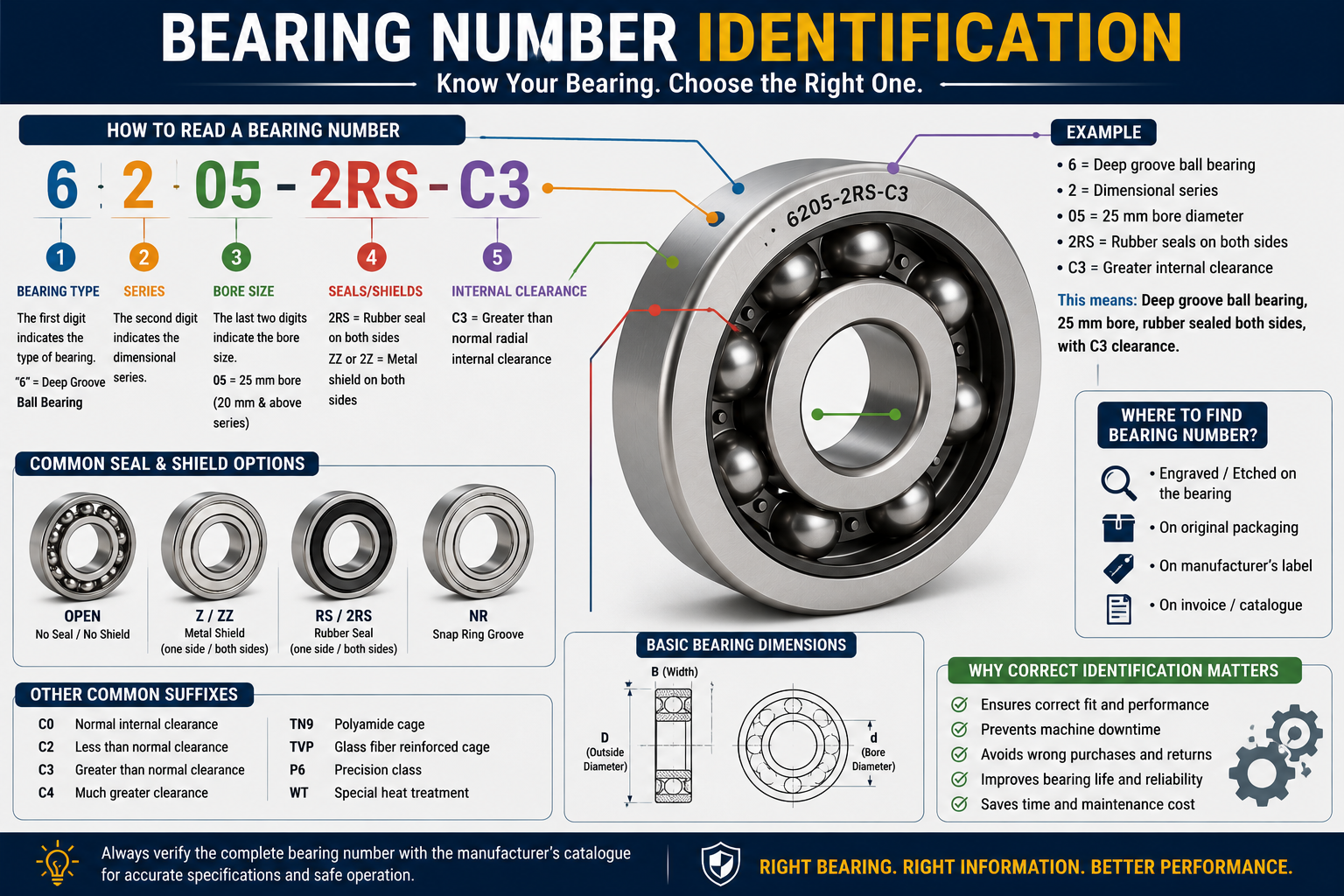
For example, you may come across markings such as 6205-2RS, 6205-ZZ, or similar designations. The exact meaning depends on the manufacturer’s numbering system, but the different sections can provide useful information.
1. Bearing Type
The first part of a bearing designation can identify the basic bearing type or series.
For example, 6-series bearings are commonly associated with deep groove ball bearings in many manufacturer’s systems. However, I always verify the catalogue because numbering systems are not universally identical across every manufacturer.
2. Bearing Series
The designation can also contain information about the dimensional series. This helps distinguish bearings that may have the same bore diameter but different outside diameters or widths.
This is important because two bearings with the same shaft size may not necessarily be interchangeable.
3. Bore Size
The bearing bore is the diameter of the hole through the inner ring. For many metric rolling bearings, the last two digits of the basic designation provide the bore code.
For example, 05 generally corresponds to a 25 mm bore in the standard 20 mm-and-above coding system. Codes such as 00, 01, 02, and 03 are special cases representing 10, 12, 15, and 17 mm respectively.
Understanding Bearing Suffixes
Suffixes are extremely important because they can describe modifications to the standard bearing design.
Seals and Shields
For example, markings such as 2RS are commonly used to indicate rubber seals on both sides, while ZZ or 2Z can indicate metal shields on both sides, depending on the manufacturer.
These configurations can affect contamination protection, lubrication retention, and operating characteristics.
Internal Clearance
You may also see designations such as C3 on a bearing.
C3 generally indicates greater internal radial clearance than the normal clearance category. I recommend never assuming that C3 is automatically better; the correct clearance depends on the application’s operating conditions.
Don’t Identify a Bearing by Number Alone
One mistake I frequently see is assuming that a bearing with a similar-looking number must be interchangeable.
I always recommend checking the bearing dimensions, manufacturer, bearing type, clearance, seals or shields, load requirements, operating speed, and application before selecting a replacement.
A small difference in specification can affect machine performance and bearing life.
Where Can I Find the Bearing Number?
The bearing designation is usually engraved, etched, or printed on the bearing itself. Depending on the product, I may also find it on the original packaging, manufacturer’s label, purchase invoice, or technical catalogue.
If the marking is damaged or difficult to read, measuring the bore diameter, outside diameter, and width can help narrow down the identification.
What If the Bearing Number Is Not Visible?
If I cannot clearly identify the original number, I avoid guessing.
I recommend recording the available dimensions, taking clear photographs, noting the machine and application, and checking the manufacturer’s catalogue. A bearing supplier can then help determine the correct designation or an appropriate replacement.
Conclusion
From my experience, understanding bearing number identification can save considerable time when purchasing or replacing bearings. The designation can provide valuable information about the bearing type, series, bore size, seals, clearance, and other specifications.
However, I always recommend verifying the complete designation with the manufacturer’s catalogue rather than assuming that every bearing number follows exactly the same convention.
The next time you see a bearing number engraved on a bearing, will you simply read it—or will you know what information it is telling you?